

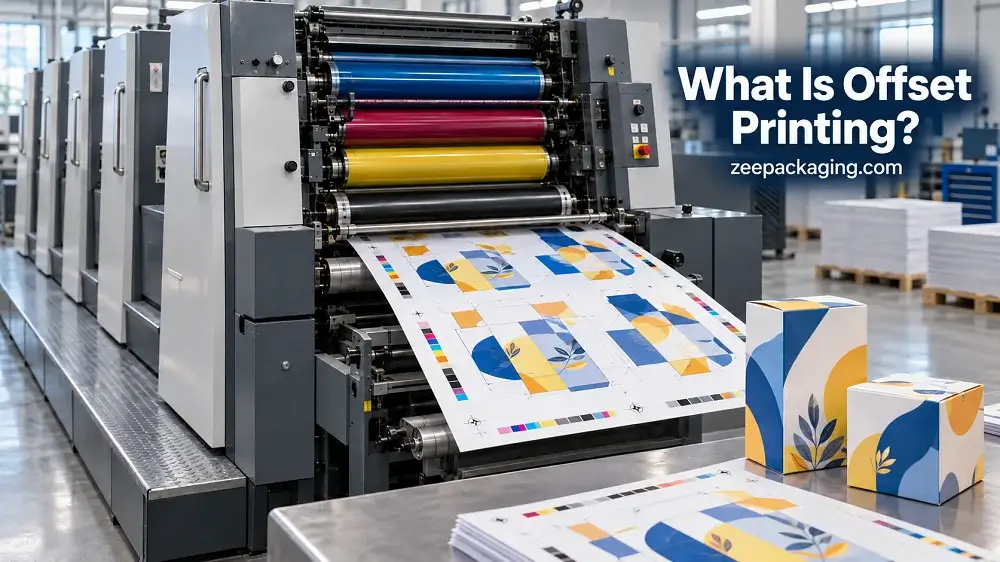
What Is Offset Printing Anyway
Offset printing, also called offset lithography, is a printing method where ink does not go directly from the plate to paper. Instead, the ink transfers from a printing plate to a rubber blanket, and then onto the paper or board.
This process works on a simple idea that oil and water dont mix. The printing plate has areas that attract ink and other areas that attract water. The ink sticks only where the design needs to be printed.
Why Offset Printing Still Rules Packaging
Digital printing is also popular, but offset printing is still widely used for custom packaging, especially for larger orders.
Here are few reasons why:
- Cost at Volume: Setup cost is higher, but the price per box usually gets lower with larger quantities.
- Color Accuracy: Pantone colors can give more consistent results for your brand.
- Sheet Size: Large printing sheets allow more boxes to be printed in one run.
- Material Options: You can choose from different materials like SBS, kraft, textured and other suitable boards.
- Ink Options: Different ink types are available depending on your printing and material requirements.
At ZEE Packaging, you can choose offset printing for your folding cartons, rigid box wraps and other custom packaging. Digital printing may also be suitable if your order quantity is small.
The Parts of an Offset Press
An offset printing machine has several parts that work together to print your artwork.
- Plate Cylinder: Holds the printing plate with your design.
- Blanket Cylinder: Transfers the ink from the plate to the paper.
- Impression Cylinder: Presses the sheet against the rubber blanket.
- Ink and Dampening System: Supplies ink and water during printing.
- Feeder and Delivery: Moves the sheets through the machine and collects them after printing.
Sheetfed offset printing is commonly used for packaging because it can print on different paperboard materials.
CMYK, Pantone and Why Color Shifts Happen
Offset printing normally uses four colors, cyan, magenta, yellow and black, also called CMYK. These colors are combined to create different shades and designs.
But some colors are difficult to match with CMYK only. If your brand needs a specific color, you can choose Pantone spot colors for better consistency.
However, printed colors may still look slightly different because of:
- Dot Gain: Ink spreads slightly on the paper surface.
- Paper Material: Coated and uncoated boards absorb ink differently.
- Ink Density: The amount of ink used during printing.
- Registration: How accurately the different colors line up.
These factors can affect the final appearance of your printed packaging.
Prepress, Where Most Problems Get Caught
Before printing starts, your artwork goes through a prepress process. This is where important details like bleed, colors, resolution, fonts and other settings are checked.
Printing plates are then prepared using Computer to Plate (CTP) technology. After that, the press is adjusted to get the correct colors and alignment.
At ZEE Packaging, your artwork is reviewed before production, and you can check the digital proof before approving your custom boxes for printing.
Offset Printing Versus Digital Printing
Both printing methods have their own benefits. The right choice depends on your order quantity, design and finishing requirements.
- Small Orders: Digital printing is often more affordable for shorter runs.
- Medium to Large Orders: Offset printing usually offers better pricing per box.
- Variable Data: Digital printing works better for different names, codes or designs.
- Spot Colors: Offset printing is a good option for Pantone and special inks.
- Large Sheets: Offset printing can handle larger printing sheets and suitable heavy boards.
At ZEE Packaging, you can discuss your requirements with our team and choose the suitable printing method for your packaging.
After the Press
Once your packaging artwork is printed, the sheets still go through other production steps before becoming finished boxes.
Depending on your requirements, you can choose from these options:
- Coating or Lamination: Matte, gloss or soft touch finishes.
- Special Finishes: Foil stamping, embossing or spot UV.
- Die Cutting: Cutting the printed sheets into your selected box shape.
- Folding and Gluing: Assembling or preparing the boxes for final use.
You can select the materials, finishes and box styles according to how you want your packaging to look.
Quick Tips Before You Send Artwork
Here are few simple things you should check before sending your packaging design.
- Prepare your artwork in CMYK instead of RGB.
- Share Pantone codes if you need specific brand colors.
- Keep your images at 300 DPI.
- Outline your fonts before sending.
- Add 1/8 inch bleed around your design.
- Avoid very small reverse text below 7pt, as it may not print clearly.
People Asked Questions
Why is offset printing cheaper in large quantities?
Offset printing has initial setup and plate costs. But when you order larger quantities, these costs are spread across more boxes, making the price per box lower.
What does dot gain mean?
Dot gain happens when printing ink spreads slightly on the paper and makes the printed dots look bigger. It is more common on uncoated and kraft boards than coated materials.
Can offset printing do metallic and white inks?
Yes, metallic inks can be used as spot colors. White ink may also be possible depending on the material and printing setup. You can also choose foil stamping or other finishing options for your packaging.
How many colors can one press run?
Offset printing presses commonly have four, five, six or eight color units. You can choose CMYK or add Pantone colors depending on your artwork and printing requirements.
Is offset printing environment friendly?
Offset printing can be more environment friendly when using suitable soy or vegetable based inks, recyclable paperboard and other available eco friendly options. Larger print runs can also help reduce setup waste per box.